Where's the Best Stablecoin Yield in DeFi? Zerion CLI + LI.FI Will Find It For You
Learn how to find the best stablecoin yields in DeFi with AI agents, Zerion CLI, and LI.FI
 Vladimir Shamanov
7 min read
Vladimir Shamanov
7 min read

Your idle stablecoins in your wallet are leaving money on the table.
Lending markets and yield vaults across DeFi are paying real, ongoing returns. The money is just sitting there when it could be working.
The problem has always been finding the best place to park stablecoins. Checking all DeFi platforms is genuinely tedious. That's what's kept most people from bothering.
This post shows how an AI agent with Zerion CLI and LI.FI turns the whole thing into a single question you can ask in plain English.
Why finding the best yield is harder than it sounds
In theory, you just pick the vault with the highest APY.
In practice:
- Yields are scattered across dozens of protocols and chains.
- The best rate for USDC might be on Base today and somewhere else next week.
- APYs move constantly, so a number you saw yesterday may already be stale.
- High headline APY can hide real risk. A small, new vault paying 15% is not the same bet as an established battle-tested protocol, paying 5%.
Finding the best yield manually means tab-juggling across yield aggregators on different chains. It can be a part-time job that seems pointless unless you have a whale-sized portfolio.
But now it’s easier than ever. Even with a small portfolio, there is no point in leaving money on the table.
The two pieces that solve it
Two tools do the heavy lifting and an AI agent stitches them together.
- What is LI.FI Earn? LI.FI is a cross-chain infrastructure that connects bridges, exchanges, and now yield vaults across the major chains. Its Earn engine scans the yield landscape for you and can route a deposit into the winner, even if your funds start on a different chain.
- What is Zerion CLI? The Zerion CLI brings your wallet to the command line, so an AI agent can read your portfolio and all stablecoin data, fund a wallet, sign transactions, and verify their status. It's how the agent knows what you hold before a move and confirms the money landed afterward.
The yield-finding workflow described here is one skill in the Zerion CLI's bundle of 30+ agent skills: lifi-earn.
Step 1. Install and set up the Zerion CLI
Open Claude Code (or any AI agent with terminal access) and point it to the setup guide for Zerion CLI or just ask it to run this command:
`npx -y zerion-cli init -y --browser`
Then, grab a free Zerion API key at dashboard.zerion.io and a free LI.FI API key at portal.li.fi.
That's the only setup. From here, you talk to your agent.
Step 2. See what you hold
Before deciding anything, give your wallet address to your agent and ask it for a portfolio snapshot.
The Zerion CLI gives a single, real-time view of everything you hold across every chain.
Now you (and the agent) know exactly how much USDC is available and where it lives.
Step 3. Find the best vaults
LI.FI's Earn engine surfaces the top yield options for your token, ranked by APY. You can filter and sort by total value locked (TVL), the status (transactional or not), and type (fixed, variable, etc)
You don't write any code. You just ask. Here's a sample prompt for your AI:
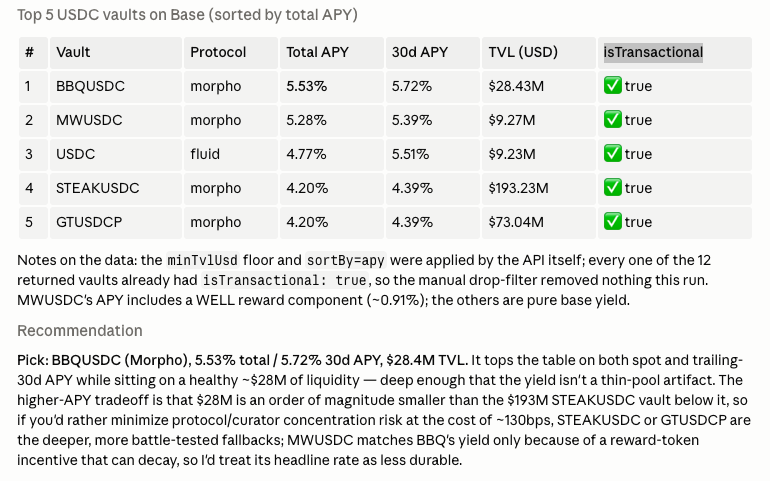
Find the best USDC yield vaults on Base. Sort by APY, ignore anything with less than $5M in TVL, and skip any vault I can't deposit into. Show me the top 5 with their APY, 30-day APY, TVL, and protocol, then recommend one and explain the tradeoff.
The AI agent will return a clean shortlist. It can also make recommendations on which vault to choose.
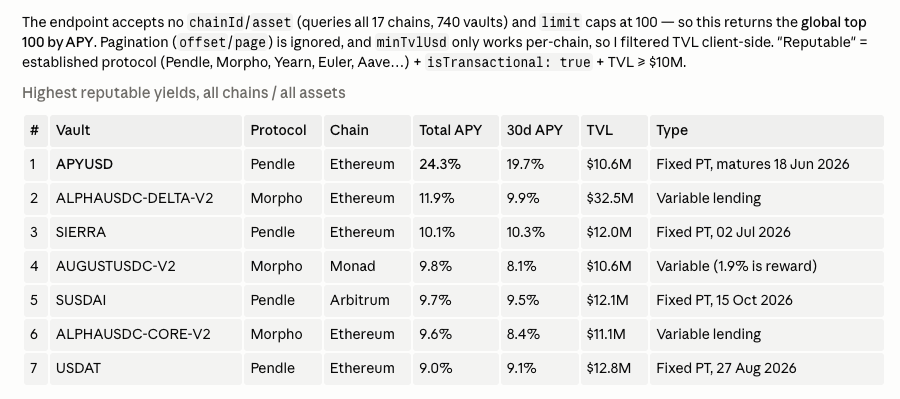
You can also just ask your agent to find the highest yields across all reputable vaults. This covers 17 chains and 740 vaults.
Here is a snapshot from LI.FI with alpha that used to feed DeFi threadors.
Step 4. Deposit in one move, even across chains
Once you've chosen, the deposit happens behind the scenes.
If your USDC is already on the same chain as the vault, it's a single step. If it's on another chain, LI.FI bridges and deposits in one orchestrated flow.
One thing to know up front: LI.FI charges a small fee on these deposit flows. It's disclosed before you confirm, so there are no surprises.
You can run this through the Zerion CLI with your AI agent after creating or importing a wallet.
Or you can deposit manually in the Zerion Wallet (which has LI.FI swaps built in).
Step 5. Confirm your money landed
Finally, the agent verifies the result.
Using the Zerion CLI, the agent can check that your new vault position shows up in your portfolio.
What this means for everyday users
Yield hunting used to be a full-time job for DeFi natives.
The same workflow is now a guided, transparent conversation: ask what's best, see the tradeoffs, deposit in one move, confirm it landed. This works for a
Try it
Set up the Zerion CLI, point your AI agent at it, and ask it to find your best stablecoin yields. Get started at zerion.io/agents.
P.S. Do you work for a protocol or a dapp? Open a PR to contribute your own skill to Zerion CLI and get featured in future content.
FAQ
What is stablecoin yield?
Stablecoin yield is the return you earn on stablecoins (dollar-pegged tokens like USDC, USDT, USDS, or DAI) when you deploy them into a lending market, liquidity pool, or another DeFi product. It's typically expressed as an APY and ranges from low single digits to double digits on higher-risk strategies.
How do you earn yield on stablecoins?
You earn yield on stablecoins by putting them to work in DeFi instead of holding in a wallet. This includes lending on protocols like Aave or Morpho, providing liquidity to stablecoin pools on DEXs like Curve or Uniswap, depositing into yield vaults like Yearn or Pendle, or holding yield-bearing stablecoins (sUSDS, sUSDe, sUSDC) that accrue yield automatically.
Who offers trusted stablecoin yield platforms?
The most established stablecoin yield venues in DeFi include Aave, Morpho, Sky (formerly MakerDAO), Ethena (sUSDe), Curve, Pendle, and Yearn. Each platform has a different risk profile.
Why is stablecoin yield attractive?
Stablecoin yield gives you onchain returns without taking on the price volatility of ETH, BTC, or altcoins. Rates often exceed what traditional savings accounts pay, the funds remain liquid, and you stay in control of your assets through a self-custodial wallet. For anyone parking capital between trades or building a longer-term position, it's a way to make idle dollars productive.
Where does stablecoin yield come from?
The source varies by DeFi product. Lending yield comes from borrowers paying interest. LP yield comes from swap fees and protocol rewards. Yield-bearing stablecoin yield comes from the underlying collateral. Always research the source before depositing. If a protocol can't explain where the yield comes from, that's a red flag.
What are the highest yield stablecoin options?
The highest yields generally come from leveraged strategies, looping vaults, and newer protocols offering token incentives. However, a higher yield always means a higher risk. Sustainable yields tend to sit in the 4–12% range, with anything above that worth scrutinizing. You can use Zerion CLI to find the highest yields.

Written by
Vladimir ShamanovVladimir has been working full-time in blockchain and crypto since 2018. Before that, he was in financial communications. He holds a BSc in Management from the LSE.
More from Vladimir Shamanov