Zerion Live: The Convergence of Crypto and AI
A summary of a Zerion Live, a conversation between Kevin (Coinbase Developer Platform), Jacob (June AI / Blockchain.com), Igor (DevRel, Bankr), Abi (Zerion), and Jules (Zerion)
 Vladimir Shamanov
5 min read
Vladimir Shamanov
5 min read
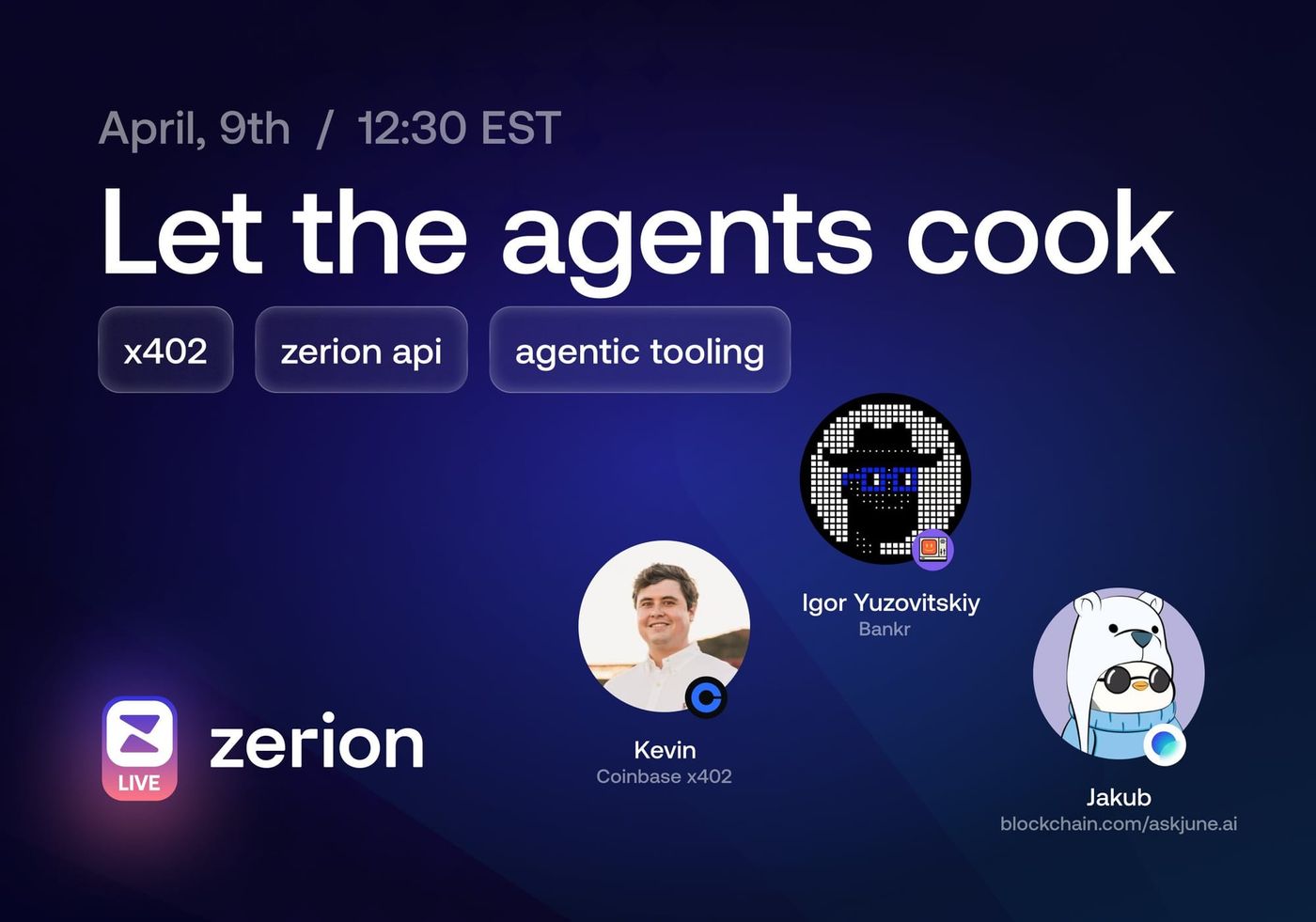
The crypto and AI industries are on a collision course. And the builders at the intersection believe we’re approaching a tipping point. In a recent roundtable discussion, leaders from Coinbase Development Platform, Blockchain.com, Bankr, and Zerion unpacked what’s happening right now: new payment standards, agent-native infrastructure, and a fundamental rethinking of how software discovers and pays for services.
Join here: https://t.co/OchsOpR7Tk
— Zerion (@zerion) April 9, 2026
x402 finds a neutral home at the Linux Foundation
The biggest headline coming into the conversation was the move of the x402 standard, a protocol for payments over HTTP, from Coinbase Labs to the Linux Foundation. Kevin from Coinbase’s Developer Platform explained the reasoning:
“Often before, even if people liked x402, they would ask, ‘Is this a Coinbase initiative? Am I just building on Coinbase?’ We wanted to dispel a lot of that and bring some of the top leaders in the industry across hyperscalers, payment service providers, credit card companies, and various AI native startups to help guide the direction of the protocol.”
The move is more than symbolic. Kevin noted that the explosion of AI-generated pull requests has made open-source maintenance harder than ever:
“You really need to spend a lot of time verifying every single pull request. Things can look super legit, because, hey, AI wrote it. But now you need a lot more humans to go through and verify each PR with a fine comb.”
Under Linux Foundation governance, x402 gains shared resources, enterprise credibility, and the neutrality needed to become a true Internet infrastructure.
Intent is the new interface
Perhaps the most provocative idea of the conversation came from Kevin’s framing of how agent commerce changes the user experience:
“Intent is the new interface… The next Google won’t look like Google. The next bank’s not gonna look like a bank. The next interface isn’t gonna look like mobile. It’s not gonna necessarily be a screen.”
Rather than users manually selecting APIs and tools, x402 lets agents reason about tool usage themselves. For example, in Zerion API, every HTTP request to an endpoint returns a 402 status code with embedded pricing information. This enables what Kevin calls “native marginal cost reasoning”:
“All the user has to care about is the intent. The agent will reason about the tools that are already available to it. It’ll do things like marginal cost reasoning, qualitative reasoning. It’ll apply that, and it’ll select the tools for you.”
Why crypto is uniquely suited for agent economies
A recurring theme was why traditional financial rails simply can’t support autonomous agents. Kevin laid out the contrast starkly:
“With crypto, you can send money to an agent. It can settle with finality in milliseconds. You don’t have to wait five days for an ACH or wire transfer.”
Jakub from Blockchain.com shared how his team has already integrated x402 into June AI for practical micropayments:
“We see a lot of users just doing micropayments. They’re having a conversation with the model and they reach their capacity for the day. They just want to finish the conversation and they pay with x402, a few cents, and they can finish it.”
The neutrality debate: One model to rule them all?
Igor from Bankr raised a critical infrastructure question of whether a single dominant AI model will win, or whether neutrality across models is the future:
“On one hand, you have a camp of ‘the strongest model will win.’ AGI will win, therefore no need for any other models. And then the other camp: infrastructure that serves as neutrality. I’m probably more in the camp of neutrality, just because of what I’ve seen with models over the last year.”
Bankr’s answer is their LLM Gateway, which offers 30+ models behind a single API key, payable in crypto:
“Not every task requires an Opus 4.6 max mode. There are some tasks that could pay 30 or 40 cents per million input tokens. You don’t need to pay $5 or $6… The agent can pay for its own compute. If it wanted a research buddy, it could spin up a new agent, send it 50 USDC, and now you got two agents running two threads of inference.”
Discoverability: The new SEO
The group converged on a critical challenge: how do agents find and choose tools? Abi from Zerion API shared a striking data point:
“Last year, we had around 3% of all our new API signups coming in referring to Claude or OpenAI as a source of how they found us. Today, that stat’s over 40%.”
Kevin framed tool discoverability as the next frontier:
“Discoverability for tool usage in many ways is kind of the new SEO. How agents make decisions on tool usage is important for businesses and builders. But tool discovery needs to be open. If you can only go to Google websites from Google Chrome and only go to Microsoft websites from Internet Edge, that would be a crappy web experience.”
Jakub emphasized the importance of diverse content formats:
“Having YouTube videos about your API, appearances in podcasts… you want to have different content types. And have some reinforcements from the community as well.”
Wallets are becoming infrastructure, not interfaces
Abi posed a question that resonated across the panel: how should crypto products be redesigned for an agentic era?
“Every wallet in the space, they’re all skeuomorphic in our designs. We are mimicking bank account UIs: a list of balances, a list of history, ‘talk to support.’ That made sense when the user was a human managing assets.”
The emerging pattern: wallets splitting into a signing/key management layer and a data layer, with agents composing across both.
The builder’s moment
Igor closed with an inspiring example of a solo developer named Kevin (@kevincodex) who built GitLawb, a decentralized Git for agents, from scratch, funded through the Banker token ecosystem:
“This is a person who solo dev’d, really did not have any resources, managed to get resources via the Banker token. We added the infrastructure around him, gave him our attention, our time, and helped him with his buildouts… It’s just a great story of a builder who really found traction and success over the last three months by being absolutely relentless.”
Kevin from Coinbase offered the final call to action:
“The best thing you can do as a builder at early stage is to build in the open and experiment. It doesn’t have to be perfect. But just share what you learned. Share how you’re thinking about economic reasoning and guardrails for agents.”
Key takeaways
- x402 at Linux Foundation creates a neutral, open standard for agent-to-agent payments over HTTP
- Micropayments unlock new commerce: use cases that traditional rails simply cannot serve
- Intent replaces interfaces: users express goals, agents handle tool selection and cost optimization
- Crypto gives agents economic autonomy: millisecond settlement, no credit scores, programmable guardrails
- Model neutrality matters: infrastructure should be model-agnostic as the AI landscape shifts rapidly
- Discoverability is the new SEO: most API users discover it through AI model recommendations
- Build in the open: agents learn from public content; locked-down docs are invisible to the next wave of users
The next episode of Zerion Live is coming in May. Make sure to follow Zerion on X so you don’t miss it.

Written by
Vladimir ShamanovVladimir has been working full-time in blockchain and crypto since 2018. Before that, he was in financial communications. He holds a BSc in Management from the LSE.
More from Vladimir Shamanov