How Pulsar Shipped Arc Day One With Zerion API
By integrating Zerion API, Pulsar launched on day one on Arc and captured the wave of early users.
 Vladimir Shamanov
3 min read
Vladimir Shamanov
3 min read
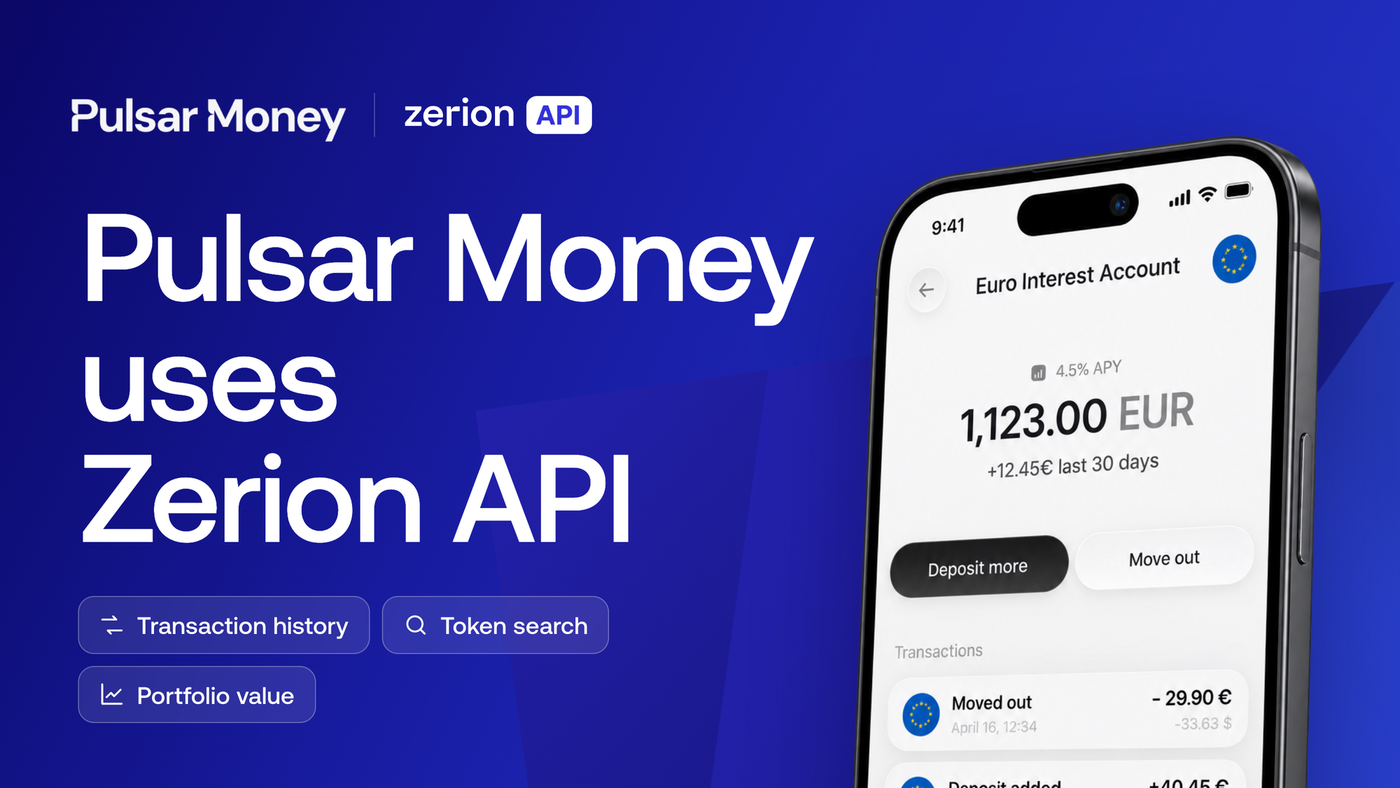
When people open an app, they want to see their balances and activity. They don’t care that a new chain that powers it went live last week.
For a consumer fintech team, meeting that expectation can mean running nodes, indexing transactions, sourcing prices, and filter tokens to show. All of that infrastructure work competes with creating the best user experience.
Pulsar Money launched as a day-one partner of Arc, the stablecoin-native Layer 1 designed by Circle, on September 16, 2026. It used Zerion API to prepare on time and handle the sudden inflow of users.
What Pulsar is building
Pulsar is building a consumer fintech app for everyday spending.
Its product offering brings together USD and EUR account details in the user’s own name and a virtual USD card for subscriptions and international purchases.
The use case is familiar: paying for Spotify, Netflix, or ChatGPT in countries where a local card gets declined. Besides that, Pulsar also offers trading through Pulsar Invest.
The product builds on Pulsar's earlier dashboard and Portals infrastructure.
But the consumer experience sets a different requirement for its data layer. When someone opens an account, they should immediately see where their money is without worrying about chains.
A launch date you don't control
Pulsar committed to Arc's first day.
That promised to attract the inflow of new users. But it also came with risks that an empty balance screen would be the user's first experience.
Building the data infrastructure internally would also create work beyond that date. Each network needs indexing, interpretation, asset identification, and price data. For a small team supporting money moving across networks and around the world, maintaining those systems can consume the time needed to improve the app itself.
Token search adds a less obvious problem.
Anyone can deploy a token with a familiar ticker. A search for USDC can encounter matching names, lookalike assets, and spam. A user who expects a dollar balance doesn’t care about this complexity.
For the app team, getting that wrong creates a support and trust problem. The interface has effectively recommended an asset by showing it.
Asset discovery also needs to work in the other direction. As tokenized stocks, treasuries, and commodities enter consumer products, the app needs to identify them as categories. A list of names and symbols leaves the application to work out what each asset represents.
Reading a new chain through existing endpoints
Pulsar already used Zerion API for balances, portfolio charts, token search, and market data.
Arc support extended that integration through the same response schema, so the team could reuse the application's existing data handling.
The integration uses five endpoints:
- Token balances: GET /v1/wallets/{address}/positions/
- Portfolio value over time: GET /v1/wallets/{address}/charts/{chart_period}
- Token search, prices, and market data: GET /v1/fungibles/
- A token identified by chain and contract: GET /v1/fungibles/by-implementation
- An asset's price history: GET /v1/fungibles/{fungible_id}/charts/{chart_period}
Zerion's day-one Arc coverage included all these endpoints. Using a shared schema meant Pulsar could add Arc coverage without building a separate Arc indexer or introducing a second response format.
That distinction matters after launch too. The application can keep its balance display logic while Zerion maintains the underlying chain data. A new supported network becomes a simple configuration task within the existing integration.
Pulsar's technical team reported no issues during the integration.
“We wanted our engineering time to go into the Pulsar experience. Having Zerion API ready for Arc meant we could build on an integration we already knew and keep our attention on getting the product ready for launch.”
— Tudor Esan, Head of Product
What shipped
Pulsar launched as an Arc day-one partner using its existing Zerion API integration. Arc balances and prices flow into the consumer experience without a separate chain data project.
Zerion API’s responses come fully interpreted, labeled, enriched with prices, and filtered for spam. No extra interpretation is needed and data is ready to be used in the product.
The integration with Zerion API enabled Pulsar to launch on time and capture the wave of new users. The app currently has a waitlist with over 20,000 users. (hint: check Zerion X account for invite codes).
What's next for Pulsar
Pulsar's next phase of work centers on expanding its consumer product experience.
As new features develop, clear balances and recognizable assets remain basic requirements. Reusing the same data integration gives the team a strong foundation to build on as other chain coverage expands
Build on the same data layer
If your roadmap includes another chain, start by testing how its data fits the screens you already have.
Get a free Zerion API key with 2,000 calls per day and explore the documentation.
For higher request rates, SLAs, and dedicated support, talk to the API team.

Written by
Vladimir ShamanovVladimir has been working full-time in blockchain and crypto since 2018. Before that, he was in financial communications. He holds a BSc in Management from the LSE.
More from Vladimir Shamanov