How Safe{Wallet} Added DeFi Positions With Zerion API
Safe Wallet used Zerion API to show users their DeFi positions.
 Vladimir Shamanov
3 min read
Vladimir Shamanov
3 min read
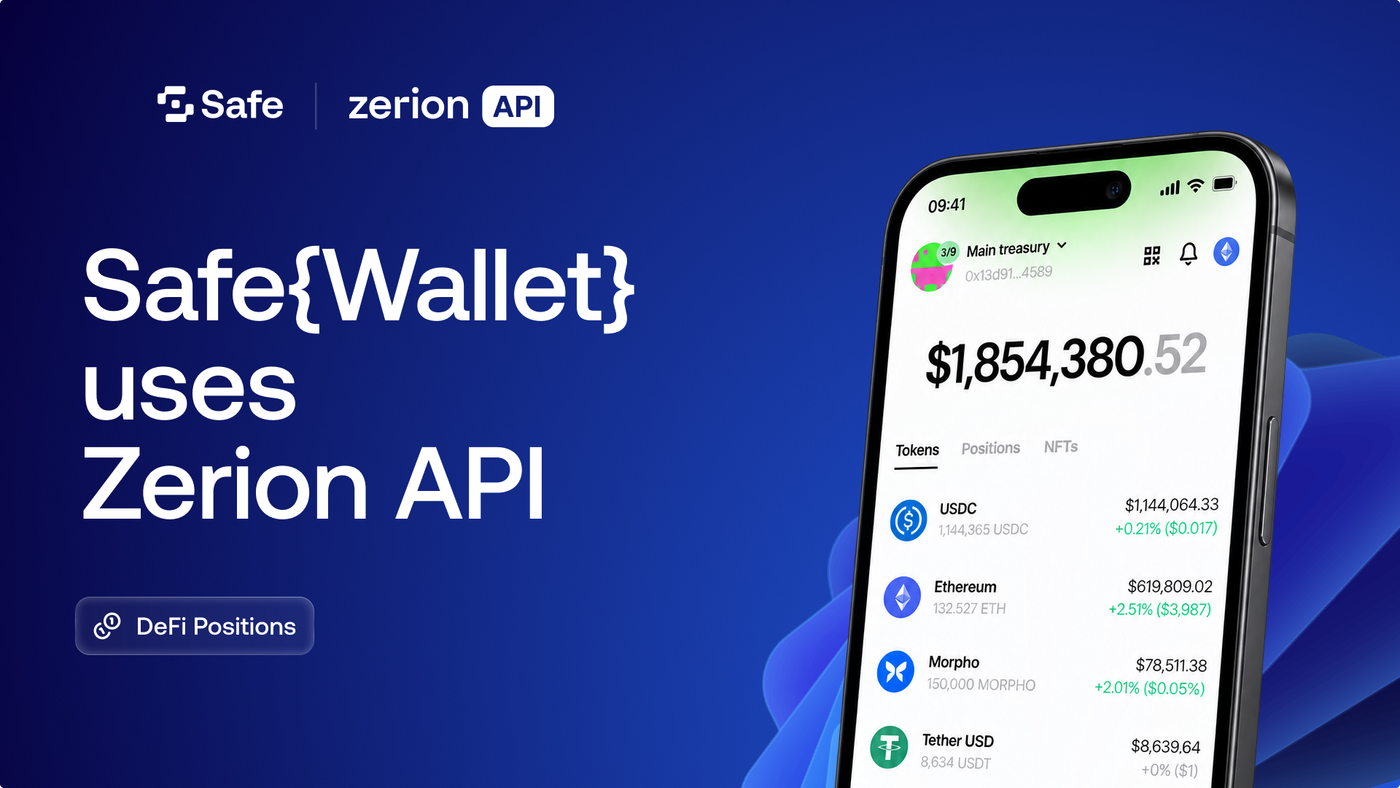
Managing crypto assets is about more than just holding tokens. Crypto portfolios also include staked assets, deposits, LPs, and other DeFi positions. However, for a long time, tracking these complex positions was a major pain point for secure multisig wallets. While users could easily see their secure vault's ERC-20 token balances, the "working capital" in DeFi often remained invisible without connecting to portfolio trackers like Zerion.
Zerion API also lets other products get the same comprehensive data. Here is how Safe Wallet used it to solve the DeFi data blind spot, giving users full visibility into their positions.
What is Safe{Wallet}?
Safe{Wallet} is the self-custody wallet for teams and individuals managing assets onchain, built on the Safe smart account standard (formerly Gnosis Safe).
Most wallets are externally owned accounts (EOAs): one private key, total control, one point of failure. A Safe is a smart contract account instead. Ownership, signing thresholds, and permissions live in the contract and are enforced onchain.That programmable multisig is why Safe became the default for teams with serious value at stake. The Ethereum Foundation, Aave, ENS, and Worldcoin run their treasuries on Safe, which secures more than $35B in onchain assets across more than 25 networks.
Because a Safe is a contract and not a keypair, it also reads differently from an EOA. Assets sit in a contract address, transactions carry approval state before they execute, and one team often operates several Safes across several chains. Showing that clearly takes more than a standard balance view.
The challenge: No DeFi positions
For a long time, Safe users faced a "blind spot" in their treasury management.
Users could easily see standard ERC-20 token balances (like USDC or ETH). But their DeFi positions (such as Uniswap LPs or lending collateral in Aave) were often invisible in the interface.
The core challenge was data fragmentation. DeFi positions live inside complex smart contracts, not just in simple balances. To display them, a wallet needs to parse each protocol contract across dozens of blockchains. Building and maintaining indexer infra in-house is an engineering nightmare that endlessly fills the backlog. It would also be distracting from Safe's core mission: security.
Without this data, Safe’s users had to rely on external dashboards to see where their treasury's money was deployed.
The solution: Zerion API DeFi positions
To solve this problem, the Safe team reached out to several major portfolio trackers with API, including Zerion.
Zerion has done the heavy lifting engineering work for its own portfolio tracker and wallet. This wallet data is now also available to developers via Zerion API.
After evaluating all the alternatives, Safe integrated the Zerion API’s positions endpoint with `only_complex` filter that fetches DeFi positions.
Key factors for choosing Zerion API included:
- Comprehensive Coverage: Zerion API supports over 4,500 protocols across 42+ EVM networks. This ensures that whether a Safe is on Ethereum, Optimism, or Base, the positions show up.
- Pre-Parsed Data: Instead of returning raw blockchain data that needs further processing, Zerion returns normalized, human-readable data. It automatically calculates the USD value of complex positions (like an LP token's underlying assets) and provides metadata like protocol names and icons.
- Team responsiveness: Zerion team was always available to answer any questions and quick to respond to any feedback.
“Zerion stood out on responsiveness. Since this was a core wallet integration, we needed a partner we could communicate with easily when questions or issues came up. I also genuinely think that Zerion provides the most accurate and fresh portfolio data in the market for a great price, after comparing all meaningful portfolio data providers.” — Valentin Seehausen, Senior Developer Relations Engineer, Safe
The impact: Better UX, total visibility
The integration transformed the Safe interface into a comprehensive portfolio manager.
Users can now see a unified view of their entire net worth, including staked assets, claims, and debts.
- Unified Dashboard: Users no longer need to open multiple tabs to check their treasury's health.
- Operational Efficiency: For DAO signers and finance teams, seeing the exact breakdown of treasury assets directly in the wallet speeds up decision-making and reporting.
- Trustless Verification: By pulling accurate data, Safe reinforces the trust users place in the interface to manage significant capital.
All Your DeFi. One Clear View. 👀
— Safe.eth (@safe) September 4, 2025
Safe{Wallet} just launched the cleanest DeFi portfolio view.
One dashboard. All your positions. No guesswork.
🔥 What's new with Positions:
- Full DeFi visibility across protocols - @aave @Kiln_finance @MorphoLabs @LidoFinance and so much… pic.twitter.com/MkWoIAASiE
What’s next for Safe
As Safe continues to push the boundaries of Smart Accounts and account abstraction, the need for rich data will only grow.
Future iterations could leverage Zerion API's endpoints across other parts of Safe’s products and data infrastructure.
Additionally, as Safe expands to new EVM chains, Zerion can help Safe users enjoy Day 1 support for portfolio tracking on emerging chains. This can all be done without any additional work by Safe engineers.
Try Zerion API
By integrating the Zerion API, Safe Wallet successfully closed the gap between securing assets and showing them, even when they are in DeFi protocols.
Ready to build the next generation of account abstraction apps?
Get your free Zerion API key and see the DeFi portfolio data in action.

Written by
Vladimir ShamanovVladimir has been working full-time in blockchain and crypto since 2018. Before that, he was in financial communications. He holds a BSc in Management from the LSE.
More from Vladimir Shamanov