Tria: Powering Neofinance App With Zerion API
 Jules
3 min read
Jules
3 min read
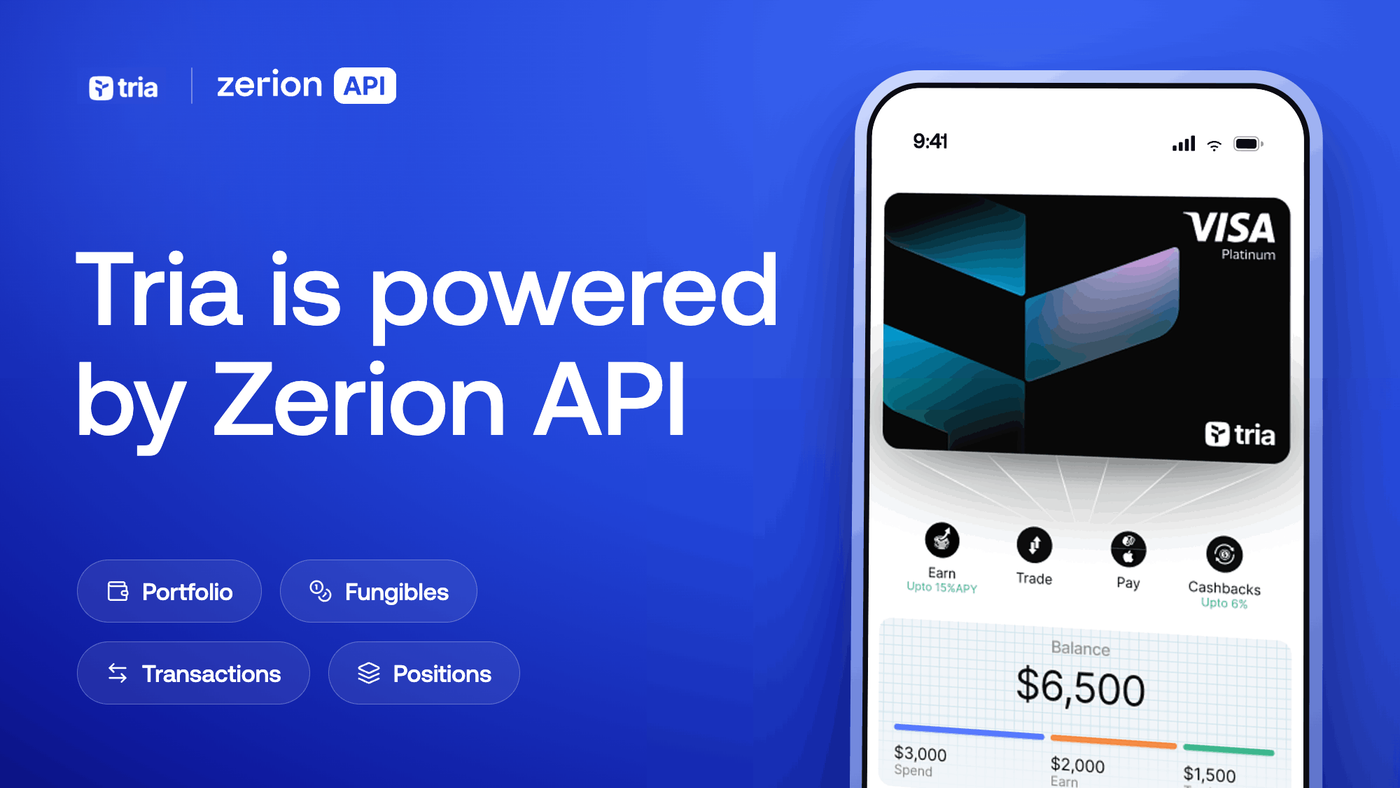
Tria integrated Zerion API to give its self-custodial neofinance app a unified portfolio view and full transaction history across Solana and every major EVM chain. All without building any infra.
Tria is a self-custodial neofinance app where people spend, earn, and hold crypto from a mobile app. Its users hold crypto across dozens of chains and in 1,000+ of tokens. For the app to feel like a modern neobank, all balances and transactions need to show up in one clean, real-time view.
Building that data layer chain by chain would have pulled Tria's engineers away from the card, Earn, and UX work that sets the product apart. That's where Zerion API came in.
What is Tria?
Tria is a self-custodial neofinance app that lets users spend, trade, and earn crypto from one mobile app on iOS and Android.
The Tria card runs on Visa and works at over 130 million merchants across 150+ countries. Users can load it with any of 1,000+ supported tokens across all major chains, including 6+ EVM chains, Solana, Bitcoin, Aptos and Tron.
Assets remain in the user's self-custodial wallet until the moment of spend. No custodian sits between the user and their money.
The app pairs the card with cashback, which flows straight back into the user's balance. A separate Earn feature also lets users put idle assets to work at up to 15% APY.
The challenge: one portfolio, dozens of chains
Tria's whole promise is a neobank-grade experience on top of multichain, self-custodial rails.
A user might hold Solana, stablecoins on an L2, and AI tokens on Base. And they still expect to open the app and see a single, dollar-denominated balance and a transaction history of everything they’ve done.
To power these features, you’d need to fetch accurate, real-time onchain data for every connected wallet, across every supported chain, and normalize it into something the app can display instantly.
Doing it in-house would have meant launching and maintaining separate indexers for EVM chains and Solana. Then decoding raw transactions and sourcing pricing. It’s an ongoing engineering burden that competes directly with shipping card, Earn, and UX improvements.
The team needed one data source that could return portfolio value and transaction history across both EVM and Solana, already interpreted and priced.
Demand for that data only grew sharper after Tria launched its Earn and Trading functionality, which drove a steep rise in wallet-data usage.
The solution: Zerion API's portfolio and transactions endpoints
Tria integrated Zerion API as the onchain data layer behind its app. Three endpoints do the heavy lifting:
- Portfolio. A single call returns a wallet's total value across every supported chain, USD-denominated, ready to render as the headline balance in the app.
- Positions. Returns the token balances with prices.
- Transactions. A clean, human-readable history that spans chains, so users get one unified activity feed instead of a per-network patchwork.
Because the Zerion API returns EVM and Solana data through the same schema, Tria gets broad coverage without manually stitching sources together. The data arrives pre-enriched with metadata and real-time pricing. It feeds straight into the app's UI.
Instead of building indexers, Tria's engineers plug into one API and spend their time on the features users actually see.
The impact: multichain visibility that scales
With Zerion API, a Tria user can hold assets on Solana or any supported EVM chain and see their full portfolio and transaction history in one view. It’s the foundation the neofinance experience is built on.
As Tria has shipped more of its product, its usage of the API has climbed steeply, with call volume already reaching into millions per month and growing.
"We have a lot more features coming soon. I'm expecting tens of millions of API calls, and a lot more than that soon. And we’re shipping faster than ever. This wouldn't have been possible without the Zerion team." — Arjun Sasikumar, Fullstack Web3 Engineer at Tria
What's next
Tria is heading into its next phase of growth with more features on the roadmap and a rising volume of API traffic behind them.
As Tria scales, Zerion API will keep powering the portfolio and transaction data at the center of the app.
Explore what Zerion API offers for your own project. Create free API keys and start building today.
Try Tria:
Trade across 200+ chains, earn up to 15% yield, and spend with your Visa card. Self-custodial, always.