Zerion Now Supports Confidential Tokens, Powered by Zama
Decrypt Zama confidential tokens natively in Zerion.
 Vladimir Shamanov
3 min read
Vladimir Shamanov
3 min read
People who come to crypto are often surprised that anyone can see everything in their wallets. That transparency makes blockchains verifiable, but it also turns every balance into a public broadcast.
MEV bots can read pending transactions and frontrun them. Copy-traders can mirror entries as soon as they appear. Bad actors can discover patterns to plan their attacks.
Confidentiality remained the missing piece: a way to keep amounts encrypted without giving up the onchain infrastructure. Zama now helps Zerion tackle this problem.
What’s new in Zerion
Zerion Wallet now supports confidential tokens and positions powered by Zama Protocol.
A confidential balance, shielded by Zama, can now appear as a position in your portfolio.
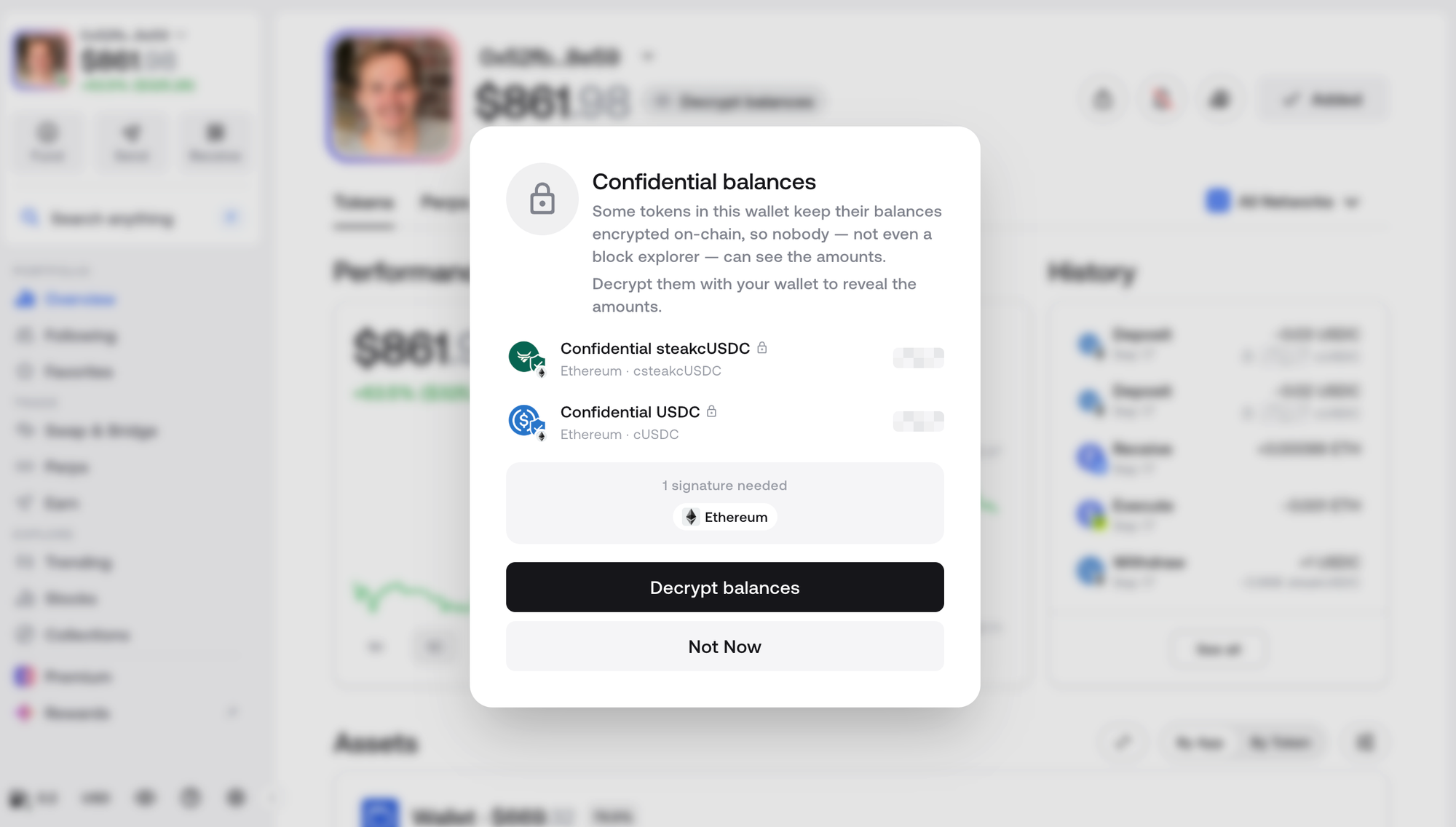
Your address and activity remain visible on Ethereum. Zama encrypts the shielded amounts, not the existence of the transaction. The useful shorthand is simple: addresses stay public, but positions are encrypted.
In the Zerion app, only you can decrypt confidential balance information and view the revealed amount. Even if you decrypt the balance, it stays visible only to you.
Others will not see your balance unless you unshield it with Zama. Native shielding and unshielding right in Zerion is coming in the next release.
How Zama confidential balances work
Zama uses fully homomorphic encryption (FHE), which lets a computer perform calculations on encrypted numbers and produce a correct result without decrypting the inputs.
The balance is a handle, not a number
On Ethereum, Zama’s confidential token balance is stored as a handle that points to an encrypted value.
A block explorer can see the handle and the surrounding transaction, but it cannot read the amount.
The contract can still update the balance. It can check that a transfer is valid, subtract from one encrypted balance, and add to another without exposing either number.
You authorize access to your own balance
When you reveal an amount in the Zerion web app, you authorize the request with a signed, time-bounded permit. Zerion can then resolve the encrypted value and display the number to you only.
Using Zama for confidential balances does not introduce a new custody model. You still fully control the wallet with the same keys.
It also requires no bridge and no separate privacy chain. The confidential assets and vault activity covered here live on Ethereum mainnet, so you do not move to a new network.
Why Zerion chose Zama
The main advantage of Zama Protocol is that it works as a confidentiality layer above existing chains rather than as a brand new L1 or L2.
That matters because confidential assets remain usable within the existing DeFi.
Confidential DeFi at scale, live today.
— Zama (@zama) September 15, 2026
Zama is the fastest growing confidentiality protocol for onchain finance.
Today, Zama expands confidential access to 16 curated yield vaults across 5 institutional curators and 5 assets: USDC, USDT, AUSD, WBTC, and tGBP, all deployed on… pic.twitter.com/OEJtKZIptP
Zama’s confidential vault, for example, deposits into an unmodified Steakhouse USDC MetaMorpho vault on Morpho. Public and confidential depositors ultimately use the same underlying vault; Zama’s contracts handle the confidential ownership layer in between.
The design differs from a mixer. Capital is not pooled and redistributed to obscure where it went.
The destination remains auditable, while individual ownership amounts stay encrypted.
The integration also rests on a published token standard. Zama’s confidential tokens follow ERC-7984, supported by an OpenZeppelin reference implementation. Zerion could build against a standard and verifiable onchain contracts instead of a partner-specific API. This is a protocol rather than a chain, built around a standard rather than a silo.
The team behind it brings a long technical record.
Zama has worked on FHE since 2020 and has raised more than $150 million. CTO Pascal Paillier invented the Paillier cryptosystem, and Chief Academic Officer Nigel Smart is a leading cryptographer. About half of Zama’s team holds PhDs.
Trail of Bits and Zenith have audited the protocol across more than 34 audit-weeks. Its key-management network uses 13 independent operators, including Ledger, Fireblocks, OpenZeppelin, Etherscan, and LayerZero, so no single operator can decrypt a balance. JPMorgan’s Kinexys has also built a proof of concept using Zama’s technology.
What comes next
We plan to expand confidential-asset support across Zerion apps.
In the future, Zerion will support more features, additional assets, and vault positions as Zama’s registry grows.
The broader direction is clear: confidential balances should behave like first-class onchain assets.
They should appear in your portfolio, move through DeFi, and remain readable to you without making every number public.
See confidential positions in Zerion
Update your Zerion iOS to the latest version or connect your wallet address to the Zerion web app. Your Zama confidential positions will show up but are only visible to you.
Visit the Zama Protocol documentation for a deeper look at the cryptography and the confidential token standard.

Written by
Vladimir ShamanovVladimir has been working full-time in blockchain and crypto since 2018. Before that, he was in financial communications. He holds a BSc in Management from the LSE.
More from Vladimir Shamanov