How Kraken Solves The Wallet Trade-Off With Zerion API
Kraken Wallet uses Zerion API to bring reliable onchain data for positions, history, and PnL across EVM networks and Solana

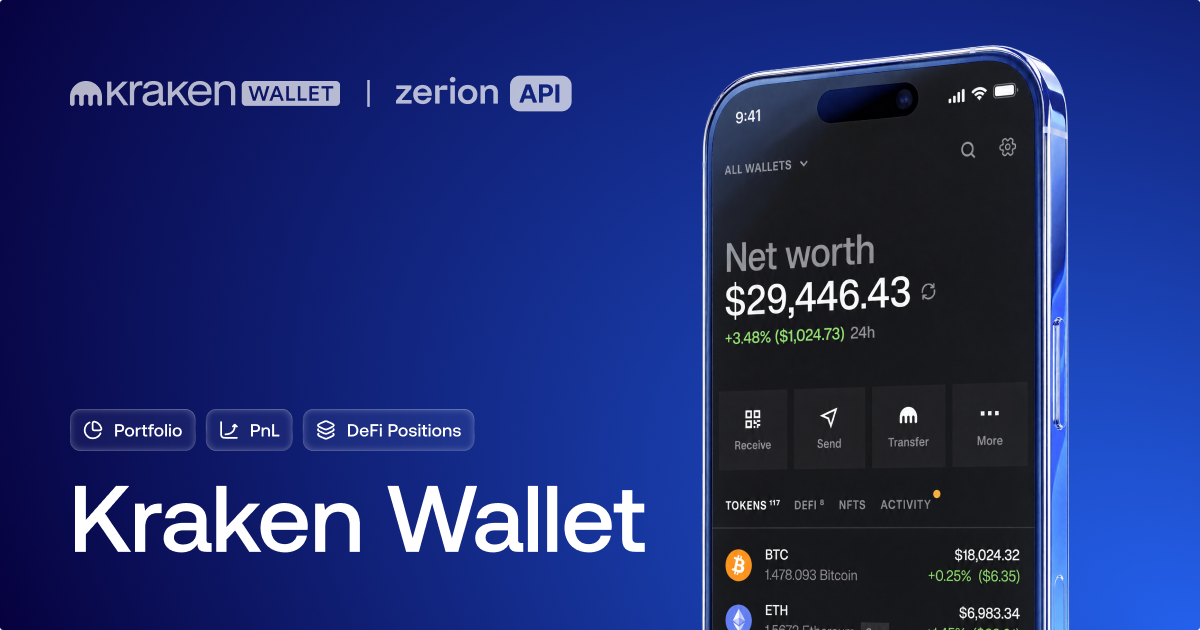
The day after the new Kraken Wallet shipped, the company did not publish a press release listing all features. Instead, the team communicated their view on what a wallet is for and a specific answer to a trade-off wallets have lived with for years.
Cold storage can keep assets isolated, but it also keeps them out of DeFi and other onchain uses. Software wallets make those activities accessible, but put more responsibility on the user.
Kraken's answer is to refuse the choice. Let people hold different pools of capital in different account types, with safeguards and access matched to how each pool will be used.
That answer creates a less visible problem.
A user's net worth may now be spread across several accounts, staked positions, loans, collateral, and tokenized assets. All of it has to be readable on a single screen and in a form that helps the user decide what to do next.
That’s one of the hardest parts of shipping Kraken's wallet vision. That's where Zerion API came in.
What is Kraken Wallet?
Founded in 2011, Kraken is one of the largest and longest-running crypto exchanges.
Its parent company, Payward, has spent fifteen years assembling banking infrastructure and regulatory licences.
Kraken Wallet is the company's open-source, self-custody multichain mobile wallet. Its code is available under the MIT licence, and users' keys never leave their devices.
The wallet is designed to bring Kraken's broader product reach into a self-custody interface without pushing a single key management model.
Kraken Wallet 2.0 went live on August 27, 2026. The release brought the wallet and Beholder, Kraken's standalone DeFi gateway, into the same app. It supports externally owned accounts (EOAs), EIP-7702 smart accounts, and embedded wallets, along with hardware signers and multi-signature accounts. A Kraken co-signer multi-sig is also in development.
This route ran through three product surfaces: Beholder, Kraken Pro DEX and, finally, the new Kraken Wallet.
The challenge: an architecture you cannot render with just token balances
Kraken's manifesto describes the architecture in one sentence:
"Instead of picking one wallet type (EOA, 7702, embedded, multisig) and living with its trade-offs, you run several side by side, with capital tiered by risk"
In Kraken's example, a multi-sig holds most of a user's funds and handles lower-risk staking. An EOA serves as a working account for borrowing and lending. An embedded wallet signs inside a trusted execution environment for an agent and quick transactions. Users can add hardware signers and existing multi-sigs. And, as the manifesto puts it, "Have as many of each as you want."
Turning that architecture into a useful portfolio view creates three data challenges.
- Aggregation across accounts. A user with four wallets across three account types still has one portfolio balance. The product has to combine an open-ended number of addresses into one view.
- Positions, not balances. Productive assets rarely sit in a plain token balance. They may be staked, lent, borrowed against, deposited in a liquidity pool or posted as collateral. A token list alone misses most of that.
- Interpretation across chains. Users need normalized, priced, and de-spammed holdings with human-readable metadata across EVM chains and Solana.
Every new network and asset class adds more indexing and maintenance work simply so users can see what they own. That work is not what Kraken's manifesto is about. It also competes for the same engineering time Kraken wanted to spend on accounts, signing, curation, and self-custody UX.
The solution: one integration across three Kraken products
Kraken first put Zerion API into production with Beholder.
Kraken’s DeFi gateway entered beta in September 2025, rolled out to a 30,000-user cohort, and launched publicly in February 2026. Zerion API supplied onchain data and transaction history.
Over time, Kraken gradually expanded the Zerion API integration and rolled it out into the new Kraken Wallet.
Zerion API’s onchain data maps to Kraken's wallet architecture in practical ways:
- One schema for many accounts. The same data model works across an EOA, smart account, embedded wallet or multi-sig, and can aggregate any number of addresses.
- Interpreted DeFi positions. The wallet positions endpoint covers liquidity provider positions, staked balances, rewards, lending and borrowing protocols across all major EVM chains.
- Parsed activity and wallet PnL. Human-readable transaction history and PnL provide the raw material for showing users what happened to their onchain portfolios.
- EVM and Solana coverage. Kraken can use one schema across both ecosystems. In March 2026, Zerion shipped Solana PnL in direct response to a Kraken request.
- Coverage for new chains. Zerion offers day-one support for all new major EVM networks, helping Kraken Wallet to further expand its coverage.
The impact for Kraken
The integration of Zerion API enabled the Kraken team to rapidly experiment with product surfaces without slowing down to work on data infrastructure.
Kraken could easily change how users enter the product while keeping the underlying wallet-data model consistent. The infrastructure powering balances, positions, history and PnL did not have to be redefined for every interface.
That consistency also creates room for the product to grow. Adding an account or product surface becomes an extension of the same read layer rather than another chain-by-chain data project.
"The integration of Zerion API in Kraken Wallet enables reliable onchain data, making it easier to scale to more users. This frees up our time and attention to build more features that give people complete control of their money." — Washington Sanchez, Director of Product Management, Kraken
What comes next
Kraken Wallet's roadmap extends beyond the account types and portfolio views available today.
Its manifesto describes xStocks that can be held and posted as collateral, K-assets such as kBTC represented, a stablecoin card, and global fiat rails.
Each addition creates another class of assets that a wallet must read, price and interpret before a user can see it. With Zerion API, Kraken already has the read layer in place to support that expanding product architecture as coverage is added and verified.
The manifesto closes the loop between the wallet Kraken has shipped and the financial access it wants to bring onchain:
"Everything Payward gains access to from here, private stocks, private credit, proprietary deal flow, will be made available onchain through the Kraken Wallet."
Read the Kraken Wallet Manifesto for Kraken's full product vision.
— subugatai (@0xsubugatai) August 28, 2026
Start building today
You do not have to choose between shipping an ambitious app and maintaining data infrastructure.
Zerion API offers normalized balances, interpreted DeFi positions, transaction history, and PnL across EVM networks and Solana. One integration can support a portfolio view today and expand with new product surfaces later.
Get free dev keys for Zerion API and see it in action.

Written by
Vladimir ShamanovVladimir has been working full-time in blockchain and crypto since 2018. Before that, he was in financial communications. He holds a BSc in Management from the LSE.
More from Vladimir Shamanov